
Caribbean co-founder
Nadeen Matthews Blair
Strategy, digital transformation and AI education.
Learning. Community. Opportunity.
Develop digital, professional and human skills through a 12-week programme that combines self-paced online modules with technical facilitators, live sessions and a community of learners.
Open to women and men.

Who we are
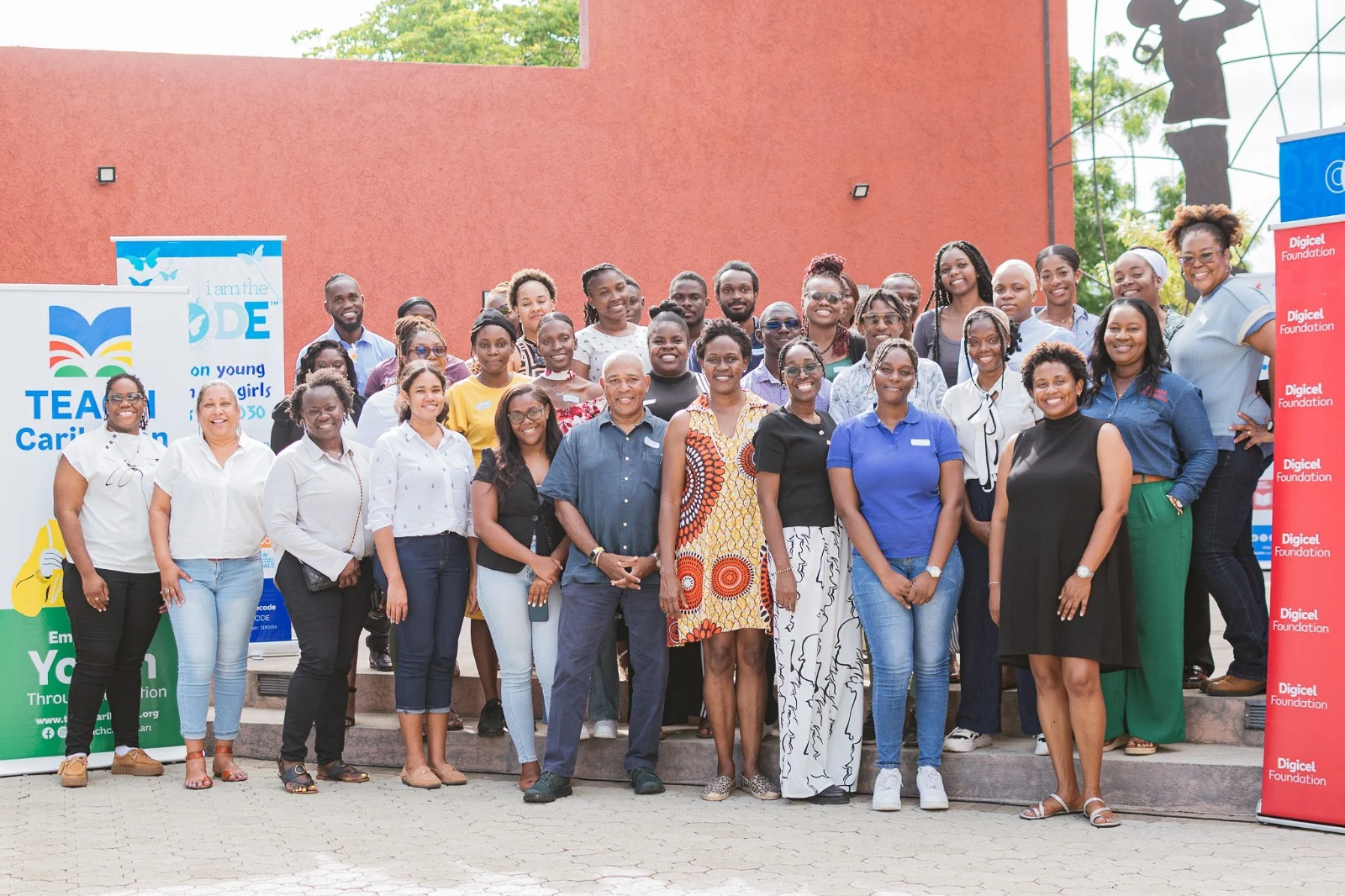
iamtheCODE Caribbean is the Caribbean affiliate of the global iamtheCODE movement, founded by Lady Mariéme Jamme. TEACH Caribbean is our local implementing partner.
We bring free digital learning to underserved young adults in Jamaica, with a vision to expand access across the wider Caribbean.
Meet the global movement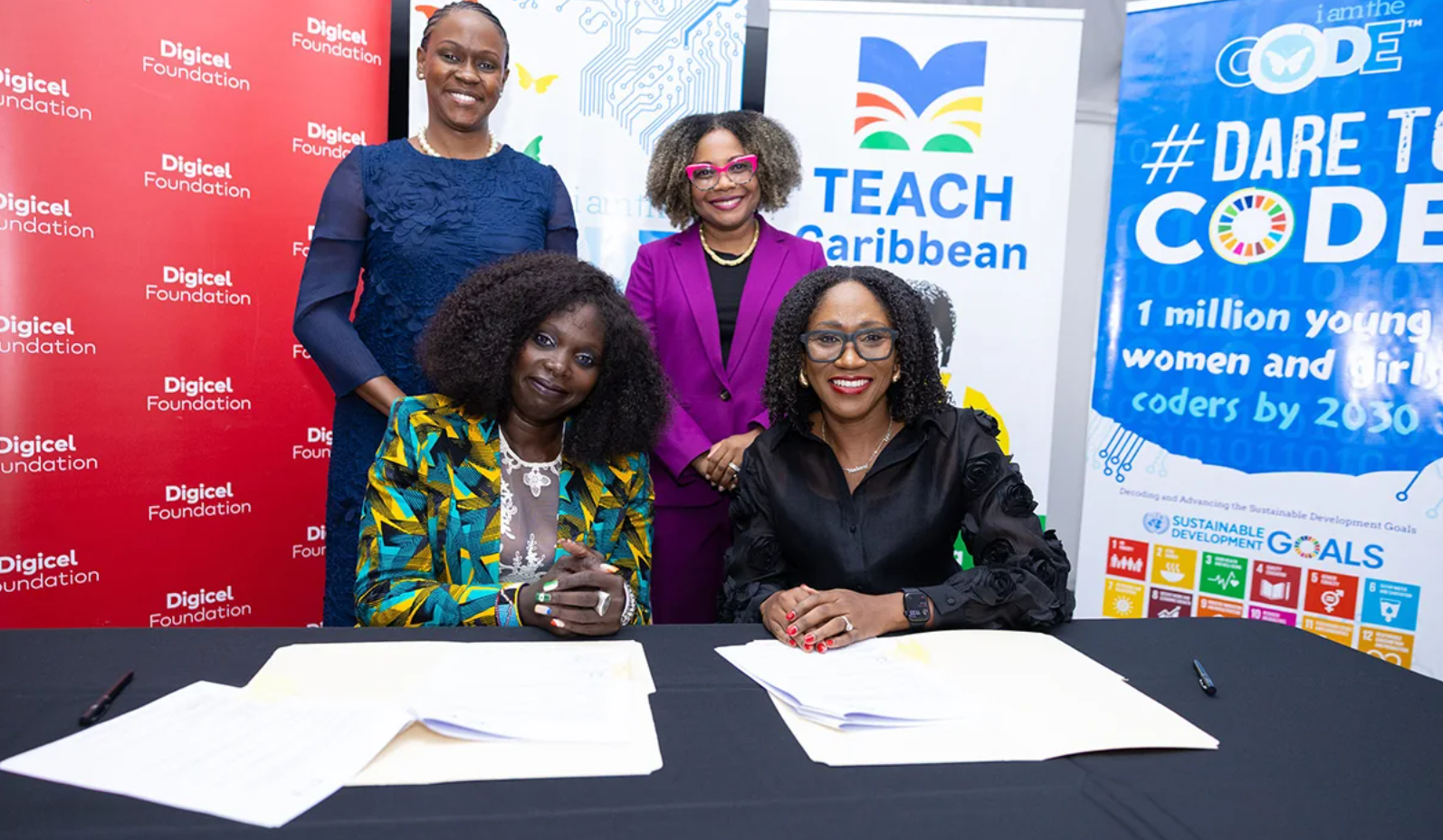
Our partnership
On October 2, 2025, Jamaica became the 89th country to join the global iamtheCODE movement, with a Memorandum of Understanding (MOU) signed in Kingston. The ceremony was attended by Lady Mariéme Jamme, Founder and CEO of the iamtheCODE Foundation, and Senator Dr. the Honourable Dana Morris Dixon, Minister of Education, Skills, Youth and Information.
iamtheCODE Caribbean was co-founded by Nadeen Matthews Blair and Mariame McIntosh Robinson, both alumni of the World Economic Forum’s Young Global Leaders programme, to bring the programme to Jamaica and then the wider English-speaking Caribbean. TEACH Caribbean is the local implementing partner.
Every place in the programme is reserved for someone who is underserved or marginalised. This is a condition of the programme and applies to all places, including those nominated by sponsors.
Caribbean co-founder
Strategy, digital transformation and AI education.

Caribbean co-founder
Financial services leadership and education through TEACH Caribbean.
Why this matters
The World Bank’s April 2024 report cites ITU estimates of ICT skills among Jamaica’s population.
iamtheCODE Caribbean provides free training and facilitator support to help underserved and marginalised learners develop digital, professional and human skills.
Source: World Bank, Digital Economy for Latin America and the Caribbean - Country Diagnostic: Jamaica, April 2024, printed page 122. The report cites ITU (2021) for these estimates. ICT means information and communications technology. These are historical estimates, rather than a current 2026 assessment.
The learning experience
Self-paced modules give learners flexibility. Facilitator guidance, live learning and in-person mixers bring people together throughout the programme.
Build foundations in HTML, CSS, JavaScript and Python, alongside learning about digital safety.
Explore project management and design thinking, with learning focused on organising work and approaching problems.
Develop communication skills and learn alongside peers, with opportunities to ask questions, share experiences and support one another.
These areas reflect the learning covered in Cohort 1. Cohort 2 details are provided through the application and onboarding process.
How we support learners
Facilitators who hold technical degrees guide learners through the programme. We supplement the online modules with these opportunities to get help and connect.
Ask questions, stay in touch with facilitators and connect with fellow learners between sessions.
Meet facilitators through live check-ins and office hours to discuss progress, questions and challenges.
Get additional guidance through live sessions on the modules. In Cohort 1, supplemental Python and JavaScript sessions were recorded and shared for learners to revisit.
Meet learners, facilitators and partners face to face, share experiences and build relationships within the programme community.
Cohort 2 aims to onboard 1,000 learners. Every place is for someone who is underserved or marginalised, with sponsorship supporting local programme delivery and learner support.
Applications close October 9, 2026.
Progress in Jamaica
March–June 2026
375 applications received for our first cohort, with 164 learners onboarded.
Learners onboarded
Our first cohort in JamaicaCompleted at least one course
82% of onboarded learnersCompleted 8 modules
30% of the 134 learners who completed at least one course24% of all 164 onboarded learnersPutting the results in context
Our learners studied during hurricane recovery, often balancing learning with work, school and family responsibilities. Facilitators, live sessions and community connections supplemented the self-paced modules.
A 2015 analysis by Katy Jordan reported a median course completion rate of 12.6%. MIT and Harvard data published in 2019 reported 3.13% completion among course participants in 2017–18.
These historical studies measured individual open online courses, with different learner populations and definitions of participation and completion. They provide background context for our supported eight-module programme.
Programme-reported Cohort 1 results. Percentages are rounded to the nearest whole number: 134 of 164 onboarded learners completed at least one course (82%); 40 of those 134 learners completed eight modules (30%); and 40 of all 164 onboarded learners completed eight modules (24%). The 1,000-learner figure is a target for Cohort 2.
Our community
September 15, 2026
Hear from Vanessa Hill, a member of our first cohort.
Watch on InstagramJuly 14, 2026
Learners reflect on favourite moments and their next steps.
Watch on InstagramSeptember 29, 2026
A national roundtable with PSOJ, iamtheCODE Caribbean and TEACH Caribbean.
View on InstagramProgramme announcements and public coverage.
Thank you to our Cohort 1 sponsors
 National Baking Company Foundation
Get involved
Cohort 2 targets 1,000 learners. Sponsorship funds the technical facilitators, in-person mixers, programme management and administration that support learners throughout the programme.
Let’s talk about partnershipSupport facilitators with technical degrees who guide learners through WhatsApp groups, live check-ins and facilitated module sessions.
Bring learners, facilitators and partners together to share experiences and build programme connections.
Support the coordination of facilitators, learning activities and programme delivery.
Support learner onboarding, communications, records and day-to-day programme administration.